Sunday, October 10, 2021

10-9-2021 St. Louis, MO

 We are actually camped in St. Charles, a pretty little town just NW of St. Louis.  Our park is situated right next to a very tall railroad trestle and also under the approach to STL.  How cool is that?! 

train trestle next to the campground

American Airlines?  Or Amazon Airlines?


We are chasing down another bucket list item:  Rob has ridden the St. Louis arch, Lindy has not.  Yet.

The goal of the historians and dreamers was to create a monument in St. Louis that would symbolize the fact that it was where the pioneers gathered to depart for the unknown mysterious West.  This was the node from which those emigrants launched.  What type of monument could symbolize that, they wondered?  The ideas of many artistic architects were solicited and many monument sketches were submitted but the obelisk was ruled out.  It just didn’t convey the concept.  Finally in 1948, the proposal of Eero Saarinen was enthusiastically accepted:  an arch, an entry point, a “gateway,” as it were.  And indeed, it stuck.  The arch is now famously nicknamed, “The Gateway to the West.”

Rob at the base


It was an enormous, herculean project, from the planning, engineering and acquisition of materials (shipped from as far away as Pittsburgh…steel) to the orchestration of the complex assembly process.  In 1963, construction began.  Tons of concrete were poured, giant cables and wires were run and thick sheets were assembled and welded.  The towers began to rise from both ends, 630 ft. apart, on 26,000 tons of concrete below the ground, section by section, with the intention to meet at the top with the final piece.  Hardhats worked at dizzying heights, sometimes in tremendous wind and snow, while surveyors with lasers kept a constant vigil. 
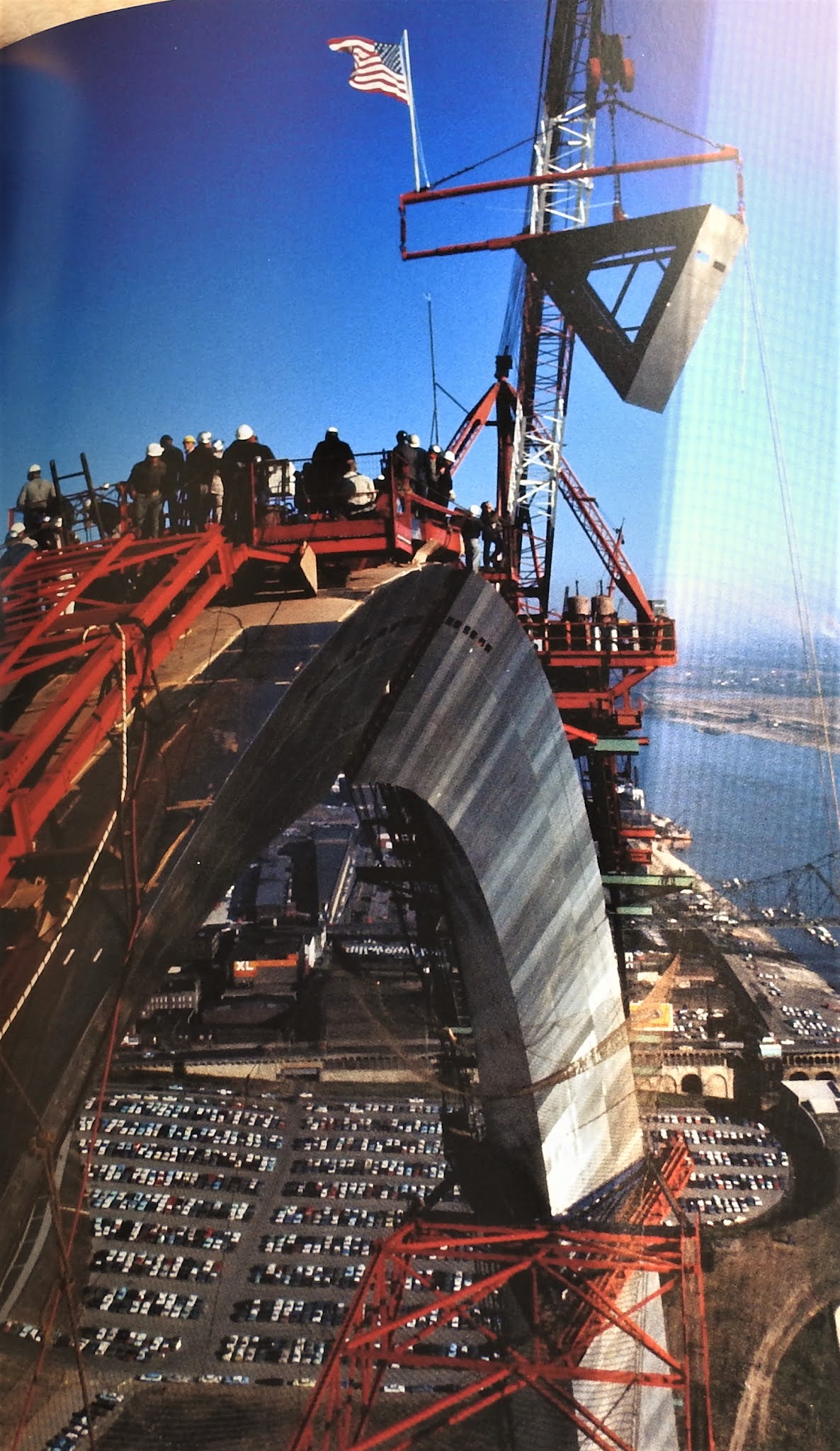
External trusswork and the
install of the last piece.
 Full disclosure:  Picture 
plagiarized from our
book on the construction 
of the arch.

When the height grew such that it could no longer be reached by the tallest cranes, a network of tracks was installed on the outside surface of the arch itself upon which the next section moved upward.  In the end, the arch is comprised of 5,200 tons of steel and 12,100 tons of concrete inside the arch and endless miles of cable.  Each triangular section weighs on average 50 tons.  On Oct. 28, 1965, the ceremonial day when the final piece was put in place, thousand gathered 630 feet below to watch.


I had heard rumors about claustrophobia in the tight cars that transport people to the top but I don’t usually suffer from that so I was ready to roll.  It turns out that the cars are not so small at all, although since it is not high season, Rob and I were the only occupants of our five-seater car that traveled up the north tower.  The staff orchestrates the loading and unloading of the cars to the second.  It takes only 4 minutes to rise to the top and there, we exited the car to a walkway where there are eight 27” X 7” windows, on either side.  Through these windows, you can see forever!  Ten minutes later, it was time to board the cars for the 3 minute descent.  Bucket list item checked off.  You are probably wondering who’s the poor bastard that has to wash the windows and how does he get up there?!  Me, too.

The white arrow points out
the windows at the top.

Inside the car.

Rob inside the car on the way up.

Peering out the window at the top.

Little doorway to car # 1

I haven't looked down at the
top of a flagpole before now!

All kinds of gov't-mandated
social distancing and masking going on.  
We were instructed to stand on the
blue dots.  We stuck our feet
outside the blue dots 3 times 
and nobody saw us!

Soon we were behind 
"door number one."

The innards of the arch as seen
through our car window.


A tug pushing a barge 
down the Missouri River,
from 630 feet above
terra firma.
Hey!  You can see the
Budweiser Brewery from up here!


Next was the movie theater to watch actual footage of the assembly process.  Just the movie looking down from those heights and watching the hardhats at work with no harnesses gave us a sickening, churning feeling.  We were relieved to learn that not a single life was lost on this project.


Waiting to board the Tom Sawyer
river boat


My activities director, Rob, did a fantastic job orchestrating this day.  We boarded the Tom Sawyer for a little cruise on the Missouri River in the warm afternoon sun.  The site that was chosen for the arch was thought through well in this chick’s humble opinion.  It is a fine sight to see right at the river’s edge.  The old county courthouse is centered perfectly from certain angles.  This courthouse was the venue in which Dred Scott lost his law suit to become a free man.  His argument was that he had lived in free states (IL and the WI Territory) and by law could no longer be held in bondage as a slave.  The case lasted 10 years and was appealed several times all the way to the US Supremes who also ruled against Dred Scott.  This decision (1857) and Abe’s Emancipation Proclamation (1862) triggered our country’s Civil War.  You are probably asking yourself why Mary Bateman Clark won her case and her freedom in 1821, right?  Here’s the answer:  It happened in Indiana, a free state, at the state Supreme Court level.  Her case never got as far as the Nine Men In Black, lucky for her! 
The Old St. Louis County
Courthouse and the arch
as seen from the water.

Having a beer in the sunshine!

Thursday, October 7, 2021

10-6-2021 Vincennes, IN

 What a drive today!  We took the country roads, not a freeway in sight!  It was green, grassy, hilly and sunny driving past the plowed fields and through small towns of America’s breadbasket.  The narrow roads do keep you on your toes, I’ll say, but it was peaceful and scenic.  We are parked at Ouabache (pronounced, “wabash”) Trails Park.  It was sunny when we arrived but the rain persistently returns.


Machine gun cart WWI - note the
horse wearing a real gas mask
Who knew anything about Vincennes, IN?  First, it is the location of the Indiana Military Museum which honors our servicemen in all branches of the USA armed forces.  Judge Jim Osborne began the collection decades ago and when it grew to be too large for him to maintain, he created the museum which now has artifacts outdoors and in two buildings. 
WWI German machine
gunner's breast plate


Gen. John Pershing's phone
at headquarters in 
Chaumont, France

Gen. George S. Patton's
dress uniform

1870 US Cavalry
dress uniform with
helmet    

One of the first 38th parallel signs
placed by the US military after
the surrender of Japan in 1945.
Later, they were replaced by permanent
metal markers.

Like all museums, it would take weeks to see all the individual pieces and read all of the plaques but there are some things that deserve a second look and a little study.  Some are original and one of a kind pieces and it is amazing that Jim has acquired this unique collection.
Drummer Boy uniform
circa Civil War Era
 
Uniform of Clarence Dowden, Jr.
Last active enlisted man of WWII

Every town in Germany had an
Adolf Hitler Street.
This sign was stolen by a US
soldier when the war was ended

May 7, 1945 issue of Time Magazine

April 23, 2003 issue of Time Magazine


Outside, among other aircraft and missiles is the sail or “conning tower” of the SS Indianapolis.  This is the tower from which the commander controls the movements of the ship when on the surface.  The sub was built for $900M and commissioned in 1977.  It was scrapped in 1998.  It would have been cool to go in the sail but it was not accessible to us tourists.

"Sail" or "Conning Tower" of the
sub SS Indianapolis


We stayed and studied everything we could until our welcome ran out and we were told it was closing time.  We had the honor of meeting Judge Jim and talking with him and then went on our way. 


Home of William Henry Harrison

While driving about town, we were surprised by the gigantic old houses on the small streets and how beautifully restored many of them are.  One beautiful old building dating back to 1803 is the home of William Henry Harrison.  He was appointed as the Governor of the Indiana Territory by President John Adams and lived in this house until he became the ninth President in 1841.  (He was the President for only 31 days and was the first to die in office.  John Tyler succeeded him.)


Knox County Courthouse
The Knox County Courthouse was built in 1873 at a cost of $362K.  At this courthouse, a famous litigation took place.  Mary Bateman Clark, a black slave born in ~1801, was brought to Vincennes by William Henry Harrison’s grandson, Benjamin, in 1814 and was indentured to William for 30 years.  She was sold to General William Johnston for $350 and was indentured to him for another 20 years.  The problem is that Indiana joined the USA as a free state in 1816 and so they apparently came up with the word, “indentured,” to get around the “slavery” issue.  Indentured meant that you signed a contract to work for someone for a period of time.  Mary Clark signed an “X” on the line and the contract agreed to pay her food, clothing and shelter.  By the way, signing an indenture was “optional,” but if a person refused to sign, he was shipped to the South and sold back into slavery.  Mary Clark lawyered up with Amory Kinney who took up her case to be freed.  He lost her case in this courthouse and they appealed to the Indiana Supreme Court where she won.  It was a landmark case, laying the groundwork and establishing a precedent for other indentured servants (read:  slaves) to become freemen.  After winning the case, Kinney was paid $10 and Mary Clark was awarded $24.44 ½ which she never saw.


Pretty painted apartment buildings

Reminds me of "Wedding Cake
Row" in Charleston, SC

We found The Café Moonlight in this town and had a nice quiet seafood dinner there.  We could actually see ourselves living in pretty little Vincennes but it loses our vote with all this rain.  Once again, it rained all night.  This morning, we set out for St. Charles, MO.  The road (Hwy 50) is rough and bumpy with cracks and potholes that rattle our teeth but it goes through many tiny little towns, vast farmlands and serene green acres and beats driving on the freeway.

Tuesday, October 5, 2021

10-4-2021 Williamstown, KY

As for Kentucky, the people here talk funny.  If you say, “Hi, how are you?” they don’t say, “Hi, I’m fine.”  They say, “Hah, ahm fahn, bless y’all fer askin.’  Y’all have a good dye!”  Also, it rains a pantload here, what’s up with that?  The humidity is 76%.  It rained all day and night.  Ugh.  I need some warm and dry.


Walnut grove at 3 Rivers RV Park

They build BIG maple trees in KY!


We are actually parked at Three Rivers Campground in Corinth, not Williamstown.  It’s a strange, funky little park with skinny little pads.  The tires almost hang off the pads.  But there are a lot of trees and grass and three streams flow through the park.  There’s so much shade that I’m guessing that nothing ever really dries out.  How do people live in all this wet, mud and cold?  The road to get here through the thick trees was so narrow that they have advisory hours for arrival and departure so that two vehicles going opposite directions don’t encounter each other because there would be no way out.  Well, we’ll see tomorrow morning how that one plays out.


Our first view of the ark
As for Williamstown:  It was our intention to camp there but we couldn’t find a place so we wound up in Corinth, not so far away.  On the bucket list was to spend a day in Williamstown at Noah’s Ark (The Ark Encounter as seen on TV).  We had tickets purchased online long ago and we made it!  There are remote parking lots and shuttles and during high season, I would think it is as crowded as Disneyland but now it wasn’t bad at all.


The first thing that happens when the ark comes into view is you gasp and say, “Oh My God!”  It is enormous and in your face.  The ark is longer than the Badger that we rode across Lake Michigan by 100 feet and wider at the beam by 26 feet.  The Badger is taller by 50 feet, though, probably because the ark can’t carry as many cars and trucks. 

Thar she blows, Rob!

Rob at the stern

Lindy at the bow

The ramp on the right was,
in theory, how the animals
got on the ark.


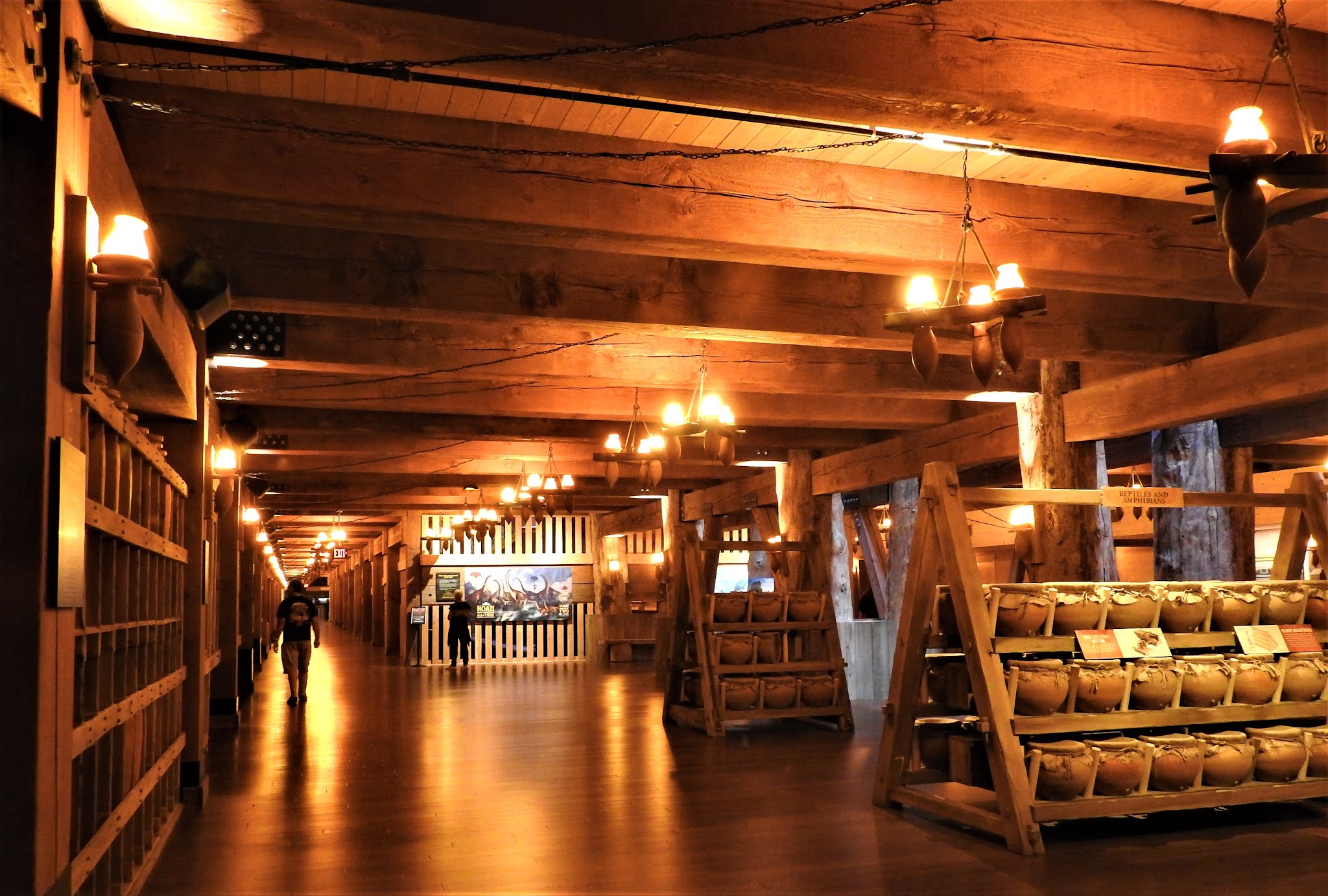
The guy who initiated the ark project, Ken Ham, started out as a high school science teacher but then he got God and became a minister.  He got so into it that he began to do quite a bit of Bible-thumping and became enthused about the Old Testament, creation vs. evolution and of course the old stories about Noah and the ark.  He and other researchers say there is evidence that Adam and Eve were created 6,000 years ago.  The Noah thing happened in 4,400 BC.  They say that Noah’s Grampa lived to be 900 years old.  When Noah turned 600, God asked him to build the ark.  God was sick and tired of all the sinning that was going on among the 145M people on the Earth at the time and He decided to trash the whole works with a flood and start over.  God told Noah he should make the ark 300 cubits X 50 cubits X 30 cubits.  Researchers say that the cubit was the average distance from the elbow to the longest fingertip, or 17.4 inches.  A “Royal cubit” was ~20.4 inches.  This ark, constructed using Royal cubits, is 510 ft. long X 85 ft. across the beam and 51 feet tall.  It took Noah 75 years to build the ark, then God told him to gather up the fam and get on board.  You may wonder about the animals and how Noah rounded them all up.  Turns out God handled that part.  The animals showed up, many of them in pairs, a male and a female, but there were more of some species.  Also God apparently decided they didn’t need to take bugs but they did take some, like butterflies and moths.  I have my own questions about some of this:  For example, did they eat the cows?  Ribeyes, don’tchaknow.  And did they eat the two chickens or keep them to lay eggs for omelets?  If the egg theory holds, then they obviously had to do the pigs in for the bacon.  In this case, Noah probably loaded up on a lot more pigs.  I mean, it makes sense, right?  (Although I looked at the prints and there wasn’t a smokehouse on the ark.  What were they thinking?!)  Did the birds eat the butterflies and the other bugs?

Fresh water supply

Rob at the centerline up at the bow 

On the right are the insect pots
covered with burlap

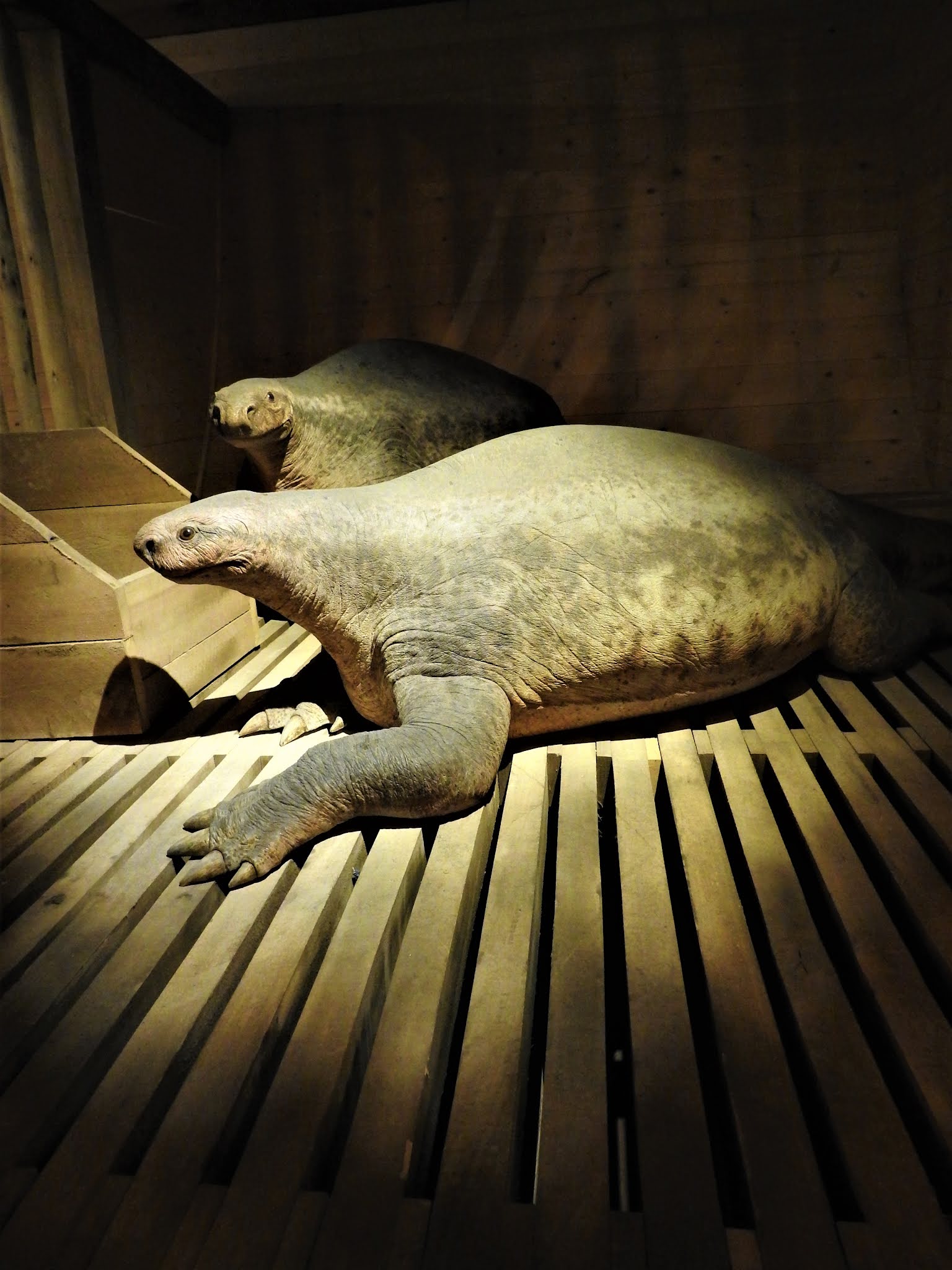
Inside the cage of one of the
animals, now extinct

We KNOW why they carried deer!  
Venison on the hoof!  They weren't
stupid!  After all, they knew what
cubits were!

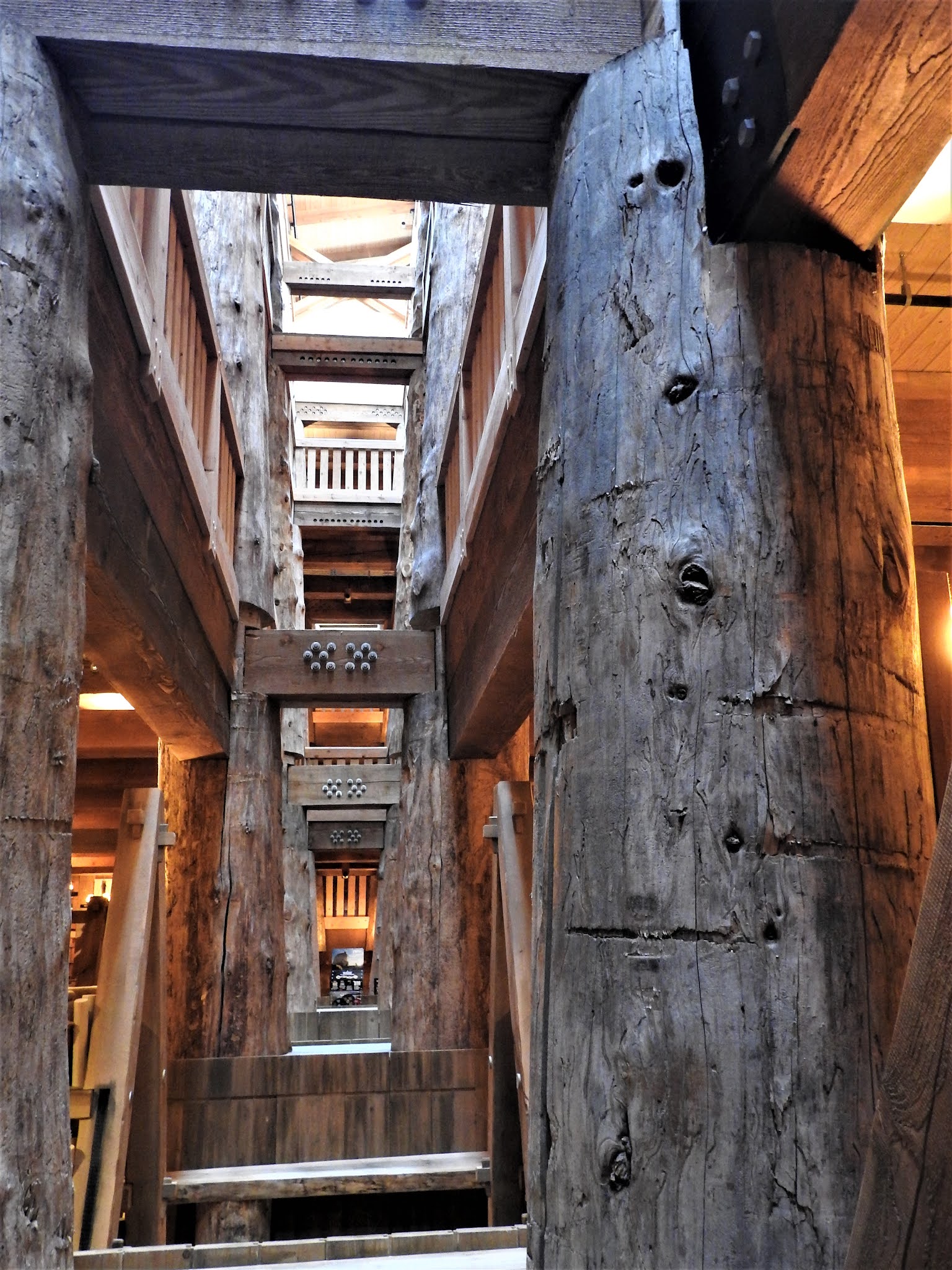
Centerline of the ship looking up

Up at the bow

Bacon on the hoof!


The seed for this ark was planted in 2004.  Engineering firms, artists, architects and money guys worked on the plans.  Finally, in 2014, construction began;  the Amish, with their spectacular woodworking talents, played a very big part in the effort, since the structure is 100% wood.  The Final cost was $100M not one penny of which came from the government or the taxpayer. They opened the doors to the public 7-7-2016, significant because 7:7 was some passage in the Bible.


The ark is quite an engineering feat and work of art.  It is as authentic as can be expected based upon a limited supply of technical data.  Some artistic license fills in the details, such as the care and feeding of the animals and where the human living quarters were situated.  There are three decks and we spent 4 ½ hours walking down and back on each deck to study the displays.  In the late afternoon, we emerged to a raging squall.  Very handy to have an ark nearby!  In time, the sun broke through between the clouds and a bright double rainbow appeared.  A rainbow at the ark!  Eerily familiar!  A rainbow appeared when Noah finally docked on Mt. Ararat, God’s symbol of the promise never to do that flooding thing again.  (Other methods were not discussed by Noah and God, as far as I know.)

The ark and the rainbow!