Sunday, August 20, 2017

BETTENDORF, IOWA 8-18-2017

We are docked here in one of the quad cities, Bettendorf (my great grandma Margaret Kraus’s maiden name, by the way).  It got its name from the Bettendorf brothers, William and Joseph, who were given a piece of riverfront land with the understanding that they would move their iron wagon factory here from Davenport.  They agreed and this was a major contribution to the economy of the area.  ALCOA, with the world’s largest aluminum mill and just a short distance down the river in Riverdale, was also a contributor to the booming growth of Bettendorf.

The Mississippi River itself has, since the beginning of time, been a major factor in the country’s successful economy, from its headwaters in Itasca, MN down to New Orleans and the gulf.  If something needed to be moved far north or far south, the river was and still is the method of choice. 
Tow with barges filled with cargo
Tows push barges up and down the river’s path and through locks that keep the water level steady, barges heavy with grain, coal, salt and other products too numerous to list.   What is not being hauled by barges is transported by trucks and trains on roads and tracks along the riverbanks.  Indeed, this river is the breadbasket of the USA.

John Deere was born in Rutland, VT in 1804 to William and Sarah Yates Deere, immigrants from Great Britain.  William decided to go back to the old country but his fate is not known.  Lost at sea, maybe?  In any case, Sarah, a tailor, was left to raise the family on a meager income.  The Deeres were poor.  As a young boy, John became an apprentice to a blacksmith and became adept at the trade.  He established a small blacksmith shop in a wooden building and of course the wood combined with the furnace did what?  Yup, it burned down.  He borrowed more money and built another blacksmith shop in a wooden building and the fate of this building was what?  Yup, it burned down.  th on the Fortune 500 list. 

Nothing runs like a deer

John and his scrape-free plow
Now a debtor, John was afraid of prison (He owed $100.) and so left town and headed for Grand Detour, Illinois.  There he once again took up the blacksmith trade.  The farmers who moved west brought their farming implements with them but found that the wet, heavy soil in the Midwest stuck to the blade and made plowing almost impossible.  Every few feet, the farmer had to stop and scrape the blade.  John was fashioning plow parts of iron in his blacksmith shop and pondered this problem.  He spotted a broken saw blade made of steel in a factory and the proprietor gave it to him.  He fashioned it into a plow blade and bazinga!  The mud did not stick to it.  He made a farmer very happy!  He obtained another piece of this wonder product, steel, and made another plow.  He couldn’t get the steel product he needed with much efficiency in Grand Detour and so moved to Moline, Iowa where steel could be shipped from the gulf up the Mississippi River.  He paid his debt, he sold his plows and the John Deere dynasty was born.  In the year 1842, John produced 100 plows.  By 1849, he had enlarged his enterprise and produced 200 plows/month.  Now, there are more than 80 plants worldwide and in 2016 the company’s gross revenue was $26 billion.  The John Deere Company is 97th in the Fortune 500 list.

Cabin of the new harvester
Rob with new race tires
We had the good fortune to tour the John Deere Harvester Works today.  Not a museum, not a gift shop.  The factory!  The mechanics were hard at work, they smiled and waved at us, the factory was sparkling clean and the colors of the day are green and yellow.  The owner of each of the $600,000 harvesters belongs to the “Gold Key Club.”  He may come to the factory and watch as his harvester takes shape moving along the factory line.  In the end, he is the first human to turn the gold key and start up his machine.  Believe me, this is a religion to these proud Iowa folks.  The words on the wall read, “Helping farmers feed the world.”  NOTHING RUNS LIKE A DEERE!
Rob in the cabin of the big ass harvester

We'll order some of these tracks for Bee for the trip home!


Big ass $600,000 harvester!
We just passed through lock # 22 on our way to Alton to see the eclipse.  We cruise lazily along under the watchful eye of many a bald eagle, heron, duck, goose and white pelican.  So far, no alligators.  Yet.  The sky is blue, the trees are changing into their Fall dresses, the river is wide and smooth.  What an experience!
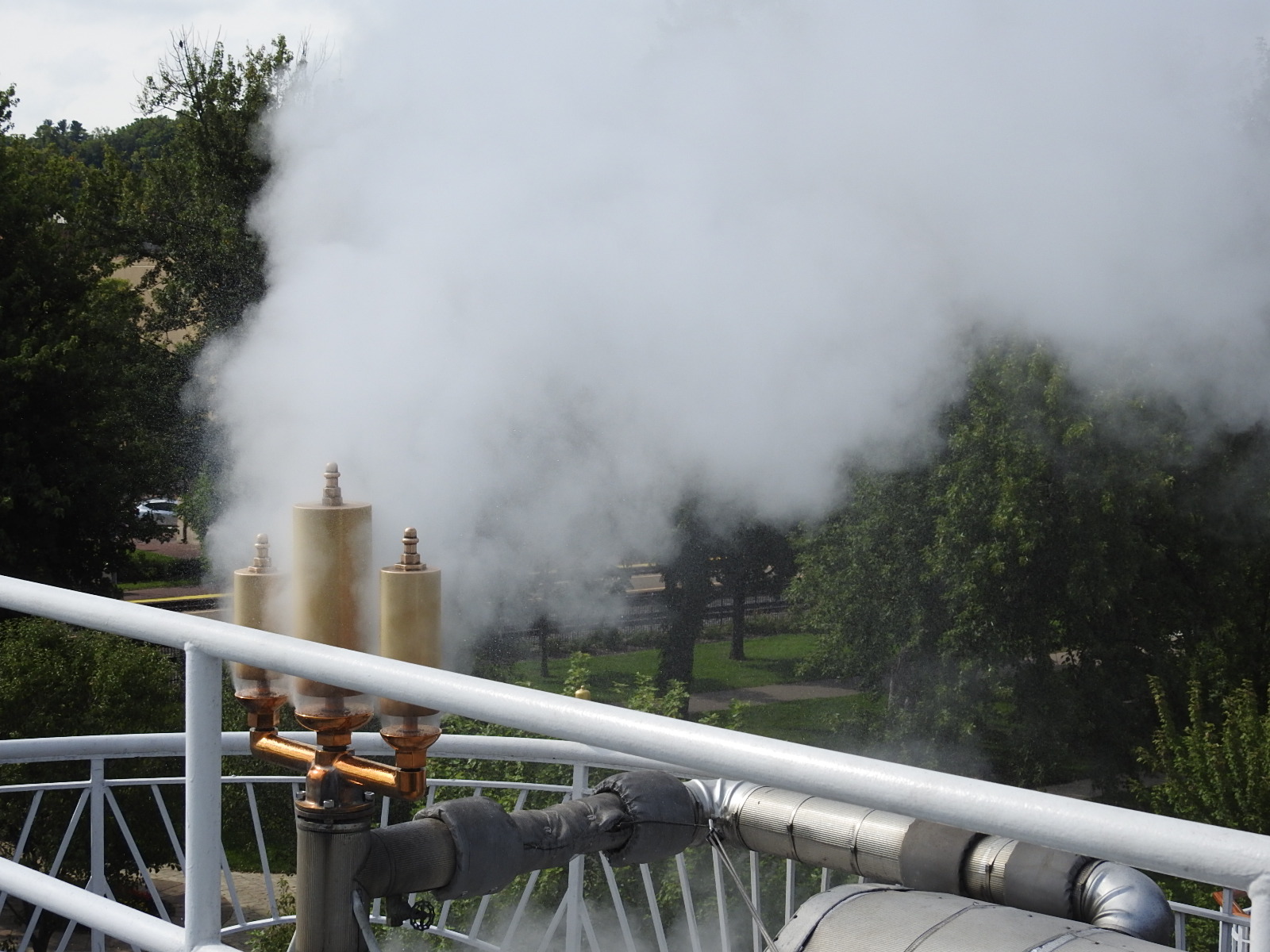
The calliope plays each time we leave a port

...or go through a lock

Raising the bridge

Raising the port stack

Rob on the top deck

Tie the ship to whatever works, I guess!

Us on the aft deck near the paddlewheel
Keeping an eye on things!

Saturday, August 19, 2017

DUBUQUE, IOWA 8-17-2017

Back up the truck for a minute.  There are some folks I must mention that have a claim to fame.

A black servant of a wealthy family in LaCrosse had a son, George Coleman Poage, who was quite a prodigy.  For one thing, George excelled in his studies and was valedictorian at his high school graduation.  He was also a champion in track and became our first black athlete to medal in the Olympics, winning two bronze in 1904.

In the early 1800s, a fellow named Cadwallader Washburn, another resident of LaCrosse, devised a better way to grind wheat into flour.  He entered a competition and, for the quality and fineness of his flour, he won!  Guess what he won.  Yup, a Gold Medal.  Mr. Washburn was a General in the Civil War and later, a company was formed that produced, for one thing, his high quality Gold Medal flour:  General Mills.

Two other famous people, Lindy Kraus DeLaMare and Carolyn (Conway) Phelan have been friends since freshman year of high school, about a half century ago.  (Jeez.)  Carolyn and Rich live right on the river in Clinton, Iowa, an hour south of Dubuque and happily, they paid us a visit here on the boat.  After the grand tour including a trip to the engine room, we sat down for brunch at the café on deck 3.  Then, they offered to show us around Dubuque.
Rich, Lindy, Carolyn, Roberto
 

There is a big pretty park along the river called Eagle Point high on the hills where you can watch ships traverse through lock # 11. 
There was a lot of wealth created here in Dubuque when a mother lode of lead was discovered, mined and marketed (in ~1788) and the very wealthy lived in magnificent homes up on these bluffs.  One of them was J. K. Graves, a banker, the town mayor and a state senator.  Allowing an hour and a half for lunch, in those days of the horse a buggy, was still not enough time to climb the hills, lunch, take a power nap and get back to work.  Mr. Graves came up with an idea. 
Riding Mr. Graves' elevator!

Two elevator cars passing in the middle
He hired an engineer, John Bell, to build him a cable car that would carry him straight up and down the bluff.  It was intended for his private use but soon, others who thought that was a brilliant and efficient creation began asking for rides.  In 1884, it was opened to the public for 5 cents per ride.  Fires destroyed the invention a few times and in 1893 during a recession, money was tight.  So tight that Mr. Graves could not afford to rebuild the lift.  The folks up on the hills had come to depend on the elevator and so a group chipped in to form the Fenelon Place Elevator Company.  The two little counterbalanced (funicular) cars are still in business today, carrying ~6 people/car up and down the cliff, passing each other midway.

Left arrow, green bridge over to Wisconsin.  Right arrow, gray bridge to Illinois.
 Between them, the American Queen.
Dubuque is situated at the point where three states converge.  If you travel west to east on the green bridge, you arrive in Wisconsin.  If you do the same on the gray bridge, you land in Illinois.  Where we stood on the veranda of our stateroom on the boat, we were in Iowa.  When Carolyn and Rich left us, we didn’t really say good bye because we were to see them one more time.  At 12 midnight, Carolyn called me from the dock at their house on the river.  “I can see you!”  It was black outside and it was difficult to make her out so she went inside and stood in the lighted bay window.  We blinked our flashlights at her and we all laughed and waved.  “Hi Carolyn!”  “Hi Lindy!  Hi Rob!”  Back in 1963, we two little girls would never have dreamed up this scenario in a million years!  What a thing!

On to the quad cities:  Davenport, Bettendorf, Rock Island and Moline.


Friday, August 18, 2017

LACROSSE, WI 8-16-2017

I may be a Wisconsin native but frankly, I don’t know much about some cities and LaCrosse is one of them.  The largest city on the west coast of Wisconsin, the population swells to 52,000 people when 20,000 college students blow into town for the school year.  It was christened “LaCrosse” by the pioneers who watched the Indians playing a game with sticks that were cruciform in shape but the town really became an item during the days of white pine logging.  Much wealth was created in the days of the timber barons.

Our first stop in town was a visit to the St. Rose Convent, Mary of the Angels Chapel and Perpetual Adoration Chapel.  In the early part of the 19th century when religious persecution began to grow once again in Europe, a group seeking religious freedom left Ettenbeuren in Bavaria and landed in Milwaukee, WI.  This small group included a few women who were Franciscan nuns.  Their goal was to build as large a chapel as their meager funds would allow and to create an eternal devotion called “Perpetual Adoration,” in which there would always be someone in prayer in the chapel, without interruption.  As a few of the sisters would arrive at the chapel a few others would leave but never was the chapel or God left unattended.  Kind of a “Tomb of the Unknown Soldier” for these guys.  As the group in Milwaukee grew, tensions caused some of the group to split away and move to LaCrosse to form their own sect.  They began the construction of the St. Rose Convent and the chapel and many craftsmen and artisans contributed their goods and talents to the project. 
The green pillars are painted concrete
The green pillars in the pictures look like marble but funds were limited and they are really polished concrete and painted to appear to be marble.  Some of the carvings, statues and the Stations of the Cross are sculpted from Beachwood and then, bronzed or gold-leaved.  The sisters were poor and donations were a primary source of funding for their grandiose plans.  Our sister guide said, “We prayed for money and somehow, it flowed in.”  (I have started praying.)
Altar

The altar is real marble from Italy

Sister practicing her harp playing

St. Rose Chapel and convent

We continued our tour to the Hixon House.  Gideon Hixon was born in Vermont in 1826.  He decided to try making a living moving west and found the timber industry in LaCrosse.  He had married Ellen by then and they came here and built a small house.  As babies began to arrive (five sons total, ultimately), they expanded their home three times.  Gideon was very successful in the lumber business and his wealth grew.  (He may have prayed for money, they didn’t say.)  He wound up founding a bank and when they couldn’t provide a loan, Gideon would loan it out of his own private stash.  Ellen, an east coaster and graduate of Oberlin, did a lot of traveling and buying of beautiful art pieces and furniture and had artists paint the walls with murals on burlap.  The artist’s autograph is still visible.  Gideon died at the young age of 66 and Ellen lived in the house until death 21 years later.  A niece moved in with her and for a while the house became a small girls’ dormitory.  Ultimately, the family decided they could not care for the residence anymore and donated it to the National Historic Society.  But here’s the interesting part:  when they did that, they left everything as it was, lock stock and barrel.  Everything in the house belonged to the Hixons, every stick of furniture, all the books in their vast library, even checks that Gideon had written but hadn’t negotiated.  They simply put everything in its place, turned the key and walked away.  Even the servants’ little aprons and white hats, those lacy little numbers that look like shower caps, are carefully laid over the kitchen chair.  The refrigerator (ice box) is clean, the pantry and beautiful old wood stove are shined and clean.  I can’t provide many pictures of the inside of Hixon House because picture-taking is not allowed.  I think they pray you will visit the gift shop and buy the book.


The house of Ellen and Gideon Hixon


Rob and I departed the tour downtown and found a good restaurant called The Steinhaus.  They had a cold beer, giant pretzel, brats and potato salad with our names on them, designed for the weary travelers.  That finished, we strolled onward toward the boat.  Later the American Queen sailed away as we bid farewell to LaCrosse, WI.

Rob and the American Queen

Wednesday, August 16, 2017

RED WING, MN 8-15-2017

Seems I run out of time and space to tell you all of the tales that are stored in my fingers.  We stayed 2 nights in MSP at the Radisson Blu Hotel located at the Mall of America.  If you have a bucket list, put Mall of America on it.  It’s like Disneyland under a roof, perfect for Minnesota where you can spend a day out of the weather in an amazing environment.  You can take an incredible ride in a simulator that is like the IMAX Theater on steroids.  It’s called, “Fly Over America.”  Do this!

Meanwhile, back at the American Queen:
In the morning, George and Ray arrived and we brought them aboard the ship to poke around.  Our stateroom was stop one but let’s get on with the fun stuff! 
Ray and George in our stateroom
There was a tour of the bridge (pilot house) on the schedule starting in the Chart Room.  Our tour guide was accompanied by one of the Captains, Allison. 
Up on the bridge

Explaining the sonar
Yes, a chick Captain… we’re doomed.  They explained all of the controls, computers and sonar equipment that these talented, experienced folks must understand and operate flawlessly.  It is really intimidating, way too much to remember.  On the fun side, the guide blew the ear-splitting steam-powered whistle for us.  One long and two shorts is the signal for, “Relax, this is just a demo.”  They also explained that the stacks collapse down if necessary to travel under bridges.  We watched this process a little later when we set sail, immediately passing under a bridge.
Blowing the steam whistle
Rob and George listen to Greg in Engineering

Down in the engine room
The engine room was next.  The boat is preparing to depart today so the engineers were a bit busy but Greg took time to show us around and explain the complex systems that move us along the river.  The engines originally belonged to the dredge Kennedy and were built in 1932.  It was a clever design that uses four steam chambers to drive twin pistons, one on either side of the paddle wheel.  These pistons are attached to the gigantic cranks that rotate the paddle wheel.  Other hardware and cables control the rudders and rudder trim surfaces which are pinned together to function in tandem.  The paddle wheel itself is massive, clocking in at almost 100,000 pounds of wood and metal.  The paddles are pine, meant to give and break if necessary, to be replaced by spares carried on board.  The spokes of the paddle are made of oak and are intended to be much sturdier. 
Lindy and Ray and a big ass paddle wheel

Big ass paddle wheel
L
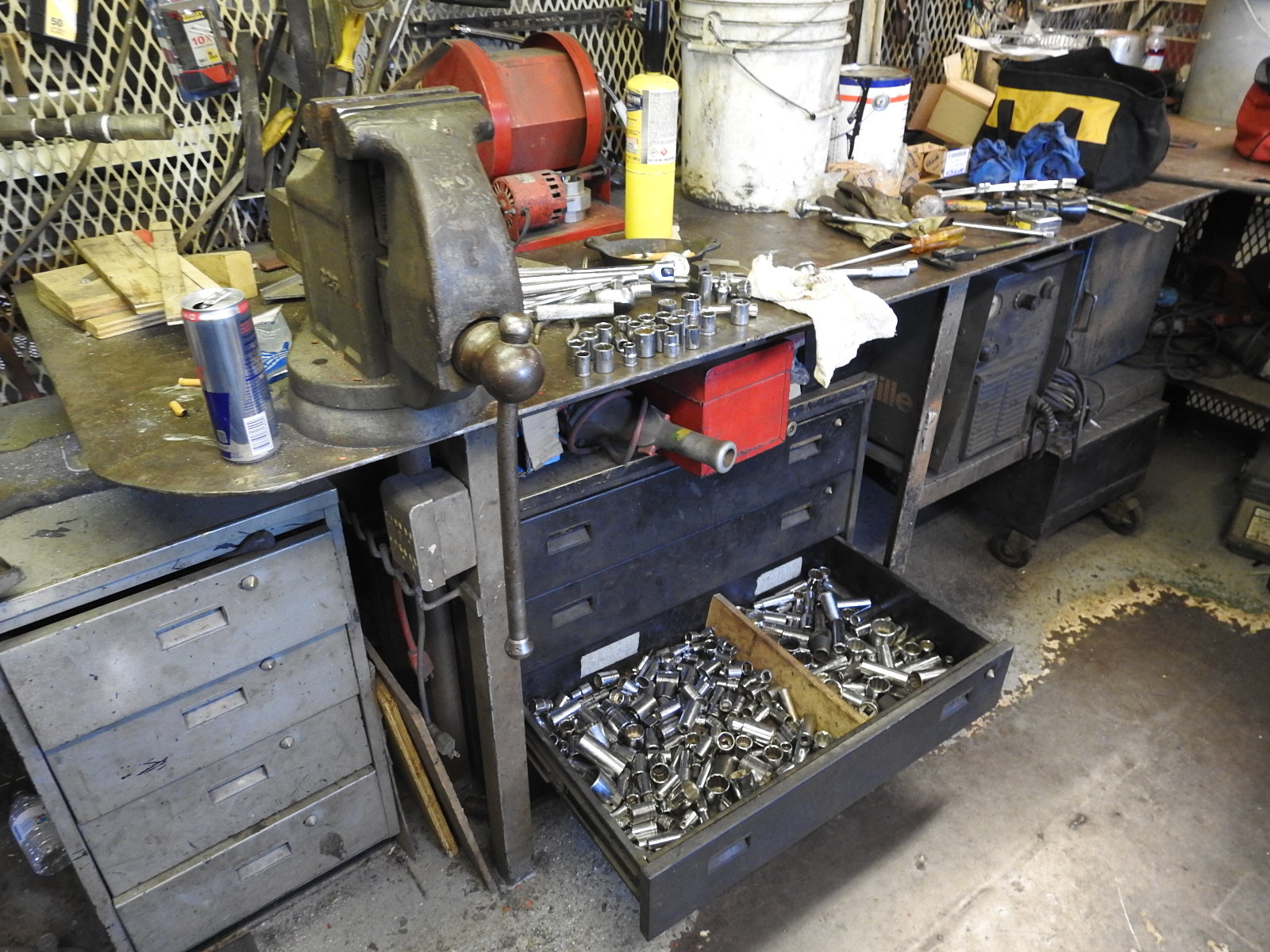
There is a machine shop in the engine room kept proudly by Mark, who can make replacements for any parts that may fail.

Rob and George in their element, the machine shop

Tools, tools, tools!  Aaaaargh!
The engineers were happy to escort us to the boiler room, next.  They grinned happily, “Hardly anybody ever asks to tour the boiler room!”  This is the heartbeat of this complex machine.  The fuel that is burned to heat the water that creates the steam that drives the engines all begins here.  Storage
In the boiler room

Look in there, George.  One hot ass fire!

We four in the boiler room
tanks, potable water provisions and hot water for every need are the purview of the trusty boiler room staff who carefully tend and monitor the machinery.  The staff told George that there is a job opening right now for an oiler in the boiler room.  George laughed and said, “Get me a pair of overalls!”

 
When the boat exploration ended, bloody marys and lunch were served at the café at the bow end.  Of course this was the perfect way to complete the experience!  After polishing off broccoli soup, baked salmon, beef brisket, fresh tomatoes, coleslaw, pumpkin pie and brownies, it was at last time to say, “good bye” to George and Ray.  Now we head down the Mississippi River!  First stop:  LaCrosse, WI.
Raising the starboard stack

Almost up!

Lunchtime!  George, Ray, Lindy and Roberto


MINNEAPOLIS-ST. PAUL, MN 8-13-2017

Time has flown!  On the evening of August 11, we celebrated our 28th wedding anniversary a day early.  The reason for this is that we knew that August 12th would be very busy, administratively.  On August 12th, it was time to batten down all the hatches on Bee and head for the airport for our flight to MSP.  We did everything we could to secure Bee including following the suggested procedure of setting out pans of desiccant.  The desiccant is meant to draw the humidity out of the air.  Humidity?  You could drown just breathing in New Orleans.  The idea is to put the crystals in a little sieve-like bowl.  They draw the water out of the air and it drips down into a pan below.  Every few days, you empty the pan.  Except that we won’t be there to empty the pan.  Plan B.  I punched holes in the bottom of two tin foil baking pans, poured the crystals into those and set one pan in the kitchen sink and one pan in the shower.  The water will run down the drain.  Tell me I’m right.  The rv park is storing Bee and the Jeep “on higher ground,” in the event of severe rains or flooding.  This higher ground is about 6 inches higher than our campsite, located on the shores of Pontchartrain Lake.  Well, as I say, we have done all we can to secure Bee and the Jeepster.  We grabbed our bags, walked away and said a prayer.

The bar served us a beer, a cup of gumbo, jambalaya and crawfish bisque while we waited for the taxi.  Another couple was sitting at the bar and they had been out on the lake doing a little fishing in their pedal-propelled rowboat.  We chatted with them awhile and I asked, “So, are there beaches?  Do people jump in and swim in the lake?”  “Oh no!” was the reply.  “There are alligators in there!”  Um, hello?  Alligators?  And we were camped 6 feet from the shoreline?  So I could step out of Bee and there in the grass is a freaking alligator?  I almost had a heart attack.  Being eaten by an alligator is high up there on the list of ways I don’t want to die.  So, in New Orleans you got your floods, tropical rain storms, hurricanes and now, you got your alligators.  It’s time to fly north.  Mosquitoes OK, alligators not so much.  Wow, I’m outta here.

Larry, Carol, Lindy, Dick (George) and Marlene
Part of the instigating mob
On August 13th, my sister Carol hosted a picnic at her house.  Seventeen of my family were there, 5 from my generation, and we had so much fun.  If you would like the rundown, from my generation were (with spouses) Dick, Carol, Marlene, Larry and me.  Then there was generation 2:  Shelly, Jason, Andy, Emily, Heather, and from gen 3, Everest and Zoey.  Well!  That was quite a reunion!  They surprised me with a birthday cake!  Yes, I’m sixty nine soon, no worries, no pain.  It was wonderful to see so many of my family for an entire afternoon!  Carol and Swede did a great job!

It’s time to prepare to board the American Queen at the top end of the Mississippi River in Red Wing, MN.  All day long, they herded us onto the buses, but when we arrived at the ship, there on the park bench sat my brother Dick (aka George – long story), waiting to see us one last time.  We were shocked!  He wanted a tour but that had to wait until the next day.  We were faced with a maze of technicalities to navigate upon arrival at the boat including a Coast Guard required safety drill.  We made arrangements to meet up and bring George and Ray on board the following morning, August 15th.

The American Queen is only 22 years old.  The paddle wheel is not just for show, it provides a significant amount of the boat’s propulsion requirements.  The boat is 418 feet long and 90 feet wide.  There are ~500 of us tourists aboard and ~200 crew members taking good care of us and the beautiful boat. – more to come -